Arthur Wellesley, Duke of Wellington
Finnegans WakeArthur Wellesley, Duke of Wellington is the central military figure in the Willingdone Museyroom, a mock museum tour that converts battle history into a sequence of exhibits, labels, and reversals. Presented first as a grand commander astride a white horse, he is successively associated with battlefield triumph, retreating opponents, captured and re-used trophies, and a final comic exchange. The scene makes his monumental public image vivid while exposing how readily military history becomes theatrical, repetitive, and unstable in its telling.
Identity and Introduction
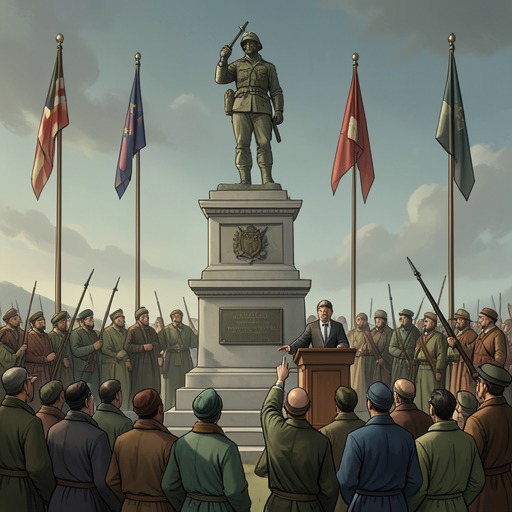
The museum guide introduces Arthur Wellesley, Duke of Wellington through the figure of “Willingdone” on his “same white harse,” surrounded by elaborate military dress and insignia. The display calls him grand and magnetic, and gives the horse as much prominence as its rider. Rather than offering a detached biography, the tour constructs the commander as a public monument in motion: a figure whose rank, costume, mount, and battlefield authority are all made into things to be pointed out and named.
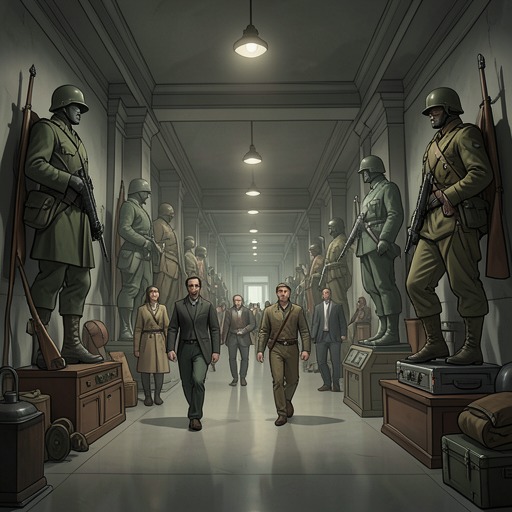
That presentation belongs to a wider landscape of memory. The surrounding description identifies the museum mound and its view toward the Waterloo country; within the museum, a succession of miniature scenes and military objects makes the distant conflict appear newly present. Wellington is at once a historical commander within the display and the organizing image around which its jokes and contests turn.
The Museum’s Battle Display
The tour begins by identifying weapons, a flag, a bullet, and the opposing force that fires on it. Its labels then move among the figures on the field: three soldiers crouch in a trench, other combatants are named by their national or military identities, and the display presents a larger force overwhelming a smaller one. Wellington’s authority appears in the repeated image of him getting the band up, a brisk cue that makes command sound like both military action and stage direction.
The opposing forces are not rendered in sober historical prose. The museum’s voice compresses them into nicknames, misspellings, and comic labels, while its invented captions make the battle seem like a toy-sized spectacle with a narrator ushering visitors from exhibit to exhibit. This form matters to Wellington’s characterization: his greatness is asserted through costume and command, but it is also made inseparable from the tour’s irreverent language and theatrical framing.
Victory, Retreat, and Reversal
The display first gives Wellington the advantage. The opponents’ dispatch appears as thin red lines across the front of an enemy figure; a reply follows, and the narration calls this exchange the first joke of Wellington, “tic for tac.” The battle then shifts toward the fleeing forces. Wellington orders fire as the scene expands into cavalry, flooding, confusion, and panic; the opposing soldiers run away, leaving their equipment behind. The sequence turns a military victory into a visual gag of pursuit and retreat.
The aftermath does not settle into dignified commemoration. The guide presents a silver plate associated with the capture of spoils and then a trophy-like object Wellington displays in his “royal divorsion” over the fleeing opponents. Even his victory is thus narrated as performance, with the museum’s succession of exhibits repeatedly converting military consequence into spectacle. The combatants’ defeat is made legible through what they leave behind, while Wellington’s triumph depends on the public display of captured material.
The last joke reverses the direction of ridicule. Wellington’s horse carries half of a three-cornered hat; Wellington hangs it at the rear of the horse, and the animal’s movement turns the trophy into an insult directed at an onlooker. The onlooker answers by blowing the remaining half of the hat away. The tour ends by declaring the game complete and asking how Copenhagen ended, so the scene closes not with a stable account of victory but with another question and another turn in the retelling.
Public Memory and Narrative Role
The Willingdone Museyroom makes Wellington a figure through whom the book tests the authority of public history. He is monumental enough to anchor a national-scale battle scene, yet the museum’s voice refuses the solemnity that such a monument might demand. Commands become cues, trophies become props, and the commander’s apparent mastery is repeatedly reframed by jokes that depend on reversals, wordplay, and the unreliable proportions of the miniature display.
Wellington also recurs outside the museum episode as part of the book’s wider circulation of public figures and inherited stories. One passage recounts a meeting between Earwicker and a stranger who asks the time; Earwicker produces his watch and answers by referring to the church bell. The episode’s language then invokes a combat claim and a monument as a sign of redemption, bringing the martial and commemorative associations attached to Wellington into a different, disputed narrative. Elsewhere, the text places Wellington among figures and names heard in passing, or uses the name amid multilingual and deliberately unstable speech. These returns do not establish a new biography; they show how the figure can be repeatedly recruited into competing stories of history, reputation, and public authority.